
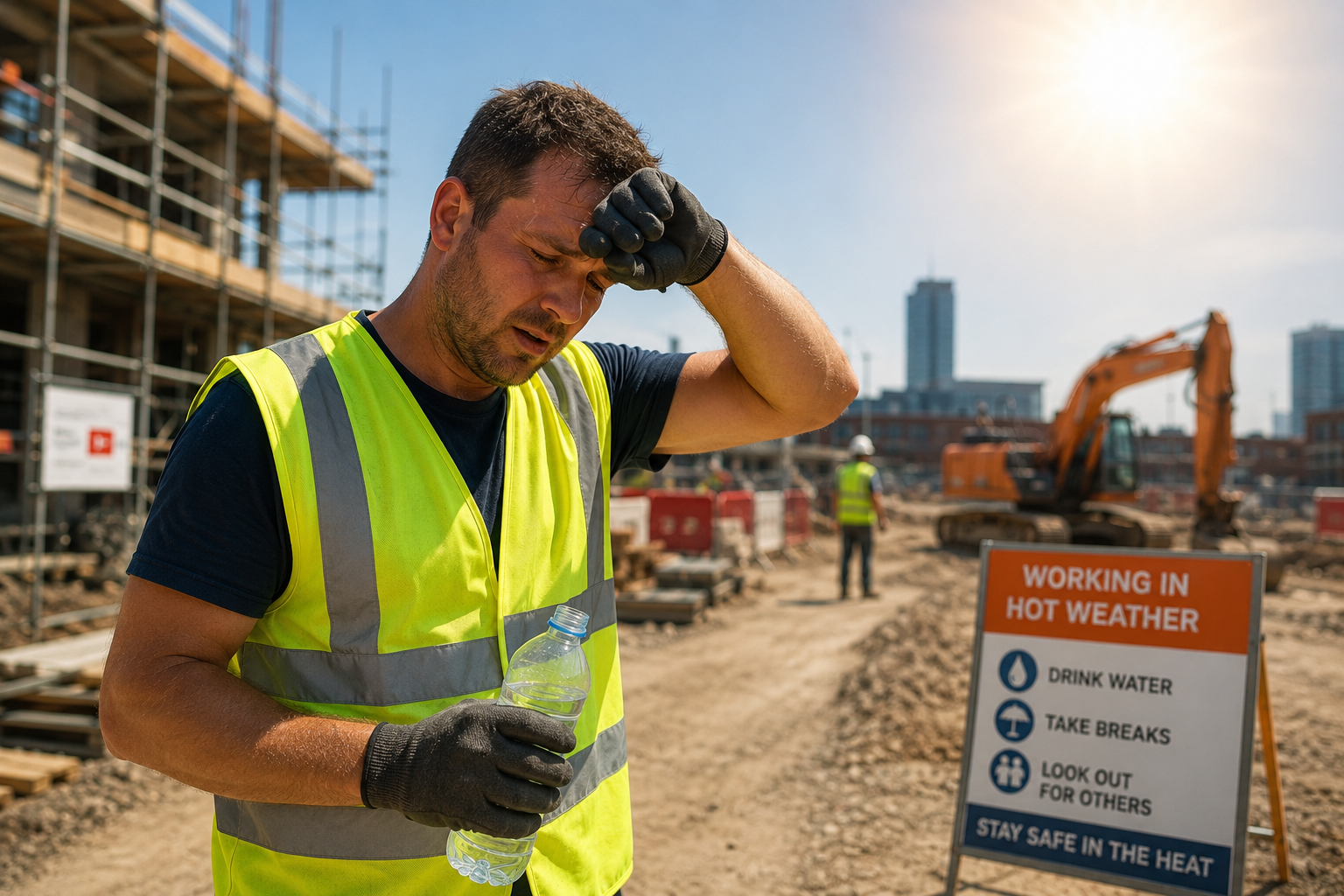
1,504 heat-associated worker deaths recorded during the UK’s hottest summer on record. No maximum legal working temperature exists in the UK — but your duty of care still applies. And 2026 is the year HSE is expected to increase scrutiny of heat risk management.
Summer is here — and with it, one of the most overlooked hazards in the UK workplace. Heat stress is not a minor inconvenience. It kills. It injures. And it exposes employers to significant legal and financial liability. Yet many businesses still have no formal plan for managing it.
This guide explains what heat stress is, the law behind it, how to spot the warning signs, and — critically — what training your team needs to stay safe and compliant.
⚠️ Employer duty of care: The Health and Safety at Work Act 1974 requires every employer to protect workers from all foreseeable harm. Courts and tribunals expect employers to act when conditions become harmful — even without a maximum legal temperature. Failure to act can result in HSE prosecution and significant civil claims.
What Is Heat Stress?
Heat stress occurs when the body’s natural cooling systems can no longer maintain a safe core temperature. Unlike physical fatigue, heat stress can escalate from mild discomfort to a medical emergency — heatstroke — within hours if warning signs are ignored.
Workers most at risk include those in construction, agriculture, utilities, logistics, warehousing, and any role involving heavy physical work or direct sun exposure. But indoor workers in poorly ventilated factories, kitchens, and laundries are equally vulnerable.
Warning Signs to Know
| Severity | Symptoms |
|---|---|
| Early | Heat rash & prickling skin, excessive sweating & thirst |
| Moderate | Dizziness & fatigue, headache & nausea |
| Serious | Muscle cramps, rapid heartbeat & confusion |
| Emergency | Loss of consciousness, heatstroke — call 999 immediately |
What Does UK Law Require?
There is no maximum legal working temperature in the UK. However, several pieces of legislation create clear duties for employers:
- Health and Safety at Work Act 1974 — requires employers to protect workers from all foreseeable harm, including thermal hazards.
- Workplace (Health, Safety and Welfare) Regulations 1992 — requires indoor temperatures to be “reasonable” during working hours, with thermometers available.
- Management of Health and Safety at Work Regulations 1999 — requires employers to formally assess risks and put appropriate controls in place.
- HSE Guidance on Thermal Comfort — while not statutory, courts increasingly reference this when determining whether an employer acted responsibly.
Key point: The absence of a maximum temperature does not reduce your liability. If a worker suffers harm and you had not conducted a heat risk assessment or put controls in place, you are likely to face enforcement action. The question courts ask is: “Was the risk foreseeable?” In a UK summer, the answer is almost always yes.
The 6-Step Approach to Managing Heat Risk
1. Conduct a Thermal Risk Assessment
Identify which workers are exposed, how often, and under what conditions. Consider work rate, clothing, humidity, ventilation, and individual vulnerability factors — including pregnant workers, older employees, and those with heart or respiratory conditions. Document controls and review the assessment when heatwave forecasts are issued.
2. Engineering Controls First
Where possible, eliminate the hazard at source. Improve natural ventilation, install fans or air conditioning, insulate hot surfaces, and schedule the heaviest work for cooler parts of the day. Engineering controls always take priority over administrative measures.
3. Administrative Controls
Rotate jobs, increase rest breaks, move work to cooler areas, and allow flexible start times during heatwaves. Provide shaded rest areas and cool drinking water — at least 250ml per hour for workers in hot conditions.
4. Acclimatise New Workers
Workers new to hot conditions should build up exposure gradually over 7–14 days. Acclimatisation significantly reduces the risk of heat illness during the first two weeks in a new environment.
5. Train Supervisors to Spot Symptoms
This is where formal training becomes non-negotiable. First aiders and line managers must be able to identify early-stage heat illness, intervene quickly, and follow your emergency procedures. A worker who is confused or losing consciousness requires immediate emergency response — not a glass of water and a sit-down.
6. Monitor and Review
Implement a simple system for workers to report feeling unwell. Never dismiss complaints of dizziness or nausea during hot weather. Review your controls after any incident and ahead of each summer season.
Which Training Courses Cover Heat Risk?
Heat stress management is embedded across several accredited qualifications available through Envico. Here are the most relevant courses:
NEBOSH Qualifications
- 🎓 NEBOSH National General Certificate — Covers thermal comfort, risk assessment, and occupational health. The benchmark H&S qualification for the UK workplace.
- 🎓 NEBOSH Construction Certificate — Essential for construction sector managers. Includes heat, UV, and outdoor environmental hazards specific to site work.
IOSH Qualifications
- 🎓 IOSH Managing Safely — Perfect for managers and supervisors who need to identify hazards, conduct risk assessments, and implement controls — including heat risk.
- 🎓 Browse All IOSH Courses — Including IOSH Working Safely, Managing Occupational Health and Well-being, and sector-specific options.
Risk Assessment & First Aid
- 🎓 Risk Assessment Training — Learn to conduct and document workplace risk assessments, including thermal comfort and heat stress controls.
- 🎓 First Aid Training — Equip first aiders to recognise and respond to heat exhaustion and heatstroke in the workplace.
- 🎓 All Health & Safety Courses — Browse the full range of general H&S training available online, in the classroom, or on-site.
Construction Sector
- 🎓 SMSTS — Site Management Safety Training Scheme — The gold-standard for site managers. Covers managing all site hazards including extreme weather and heat exposure.
- 🎓 SSSTS — Site Supervisor Safety Training Scheme — For supervisors on construction sites. Includes practical hazard management and supervisory responsibilities.
Don’t Wait for a Heatwave Warning
The most common mistake employers make is treating heat as a reactive issue — only acting when a forecast hits 30°C. By then, untrained supervisors, absent risk assessments, and insufficient rest provisions put lives at risk.
The right time to train your team, update your risk assessments, and put your heat management plan in place is now — before temperatures peak. The law expects it. Your workers deserve it.
Ready to Get Your Team Trained?
Browse accredited heat risk, risk assessment, and health & safety courses across the UK — online, in the classroom, or on-site at your premises.
📞 Or speak to our team: 0808 1966 830